AI is creating new opportunities for Health IT companies while changing how investors assess growth, competitive advantage and value. Healthcare’s regulatory complexity and deeply embedded workflows create structural moats, especially for companies that serve as systems of record. Their established role in managing data and workflows can give incumbents an advantage in deploying AI, even as new competitors challenge their products and business models. Against a backdrop of higher capital costs and more selective valuations, we examine how these risks and opportunities are shaping the Health IT market.
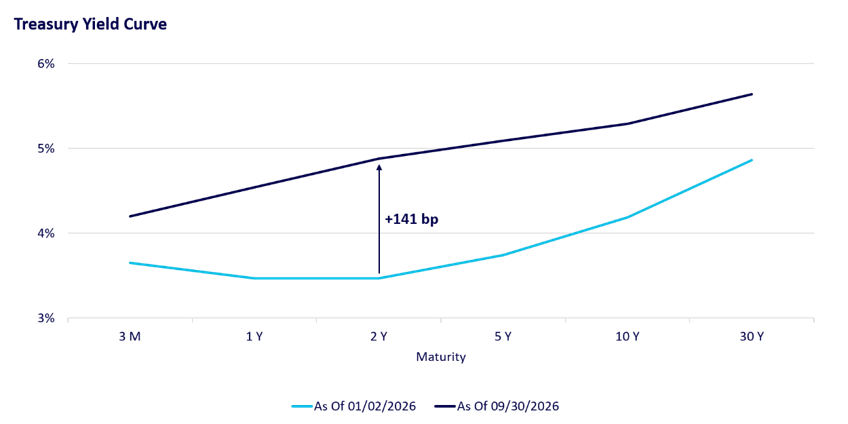
Interest rates have reversed course, and markets now expect higher for longer. Expectations have shifted from two Fed rate cuts at the start of the year to two rate hikes. Yields have risen across the curve, with growing federal borrowing needs adding pressure on long term rates, with the 10 and 30-year reaching their highest levels in 20+ years. Meanwhile, a resilient economy has given the Fed room to raise rates as inflation remains stubborn, compounded by the Iranian conflict. Higher rates are increasing the cost of capital just as the economy enters a period of heavy investment. They are also pushing companies to prioritize profitability, potentially at the expense of growth, a theme we will revisit.
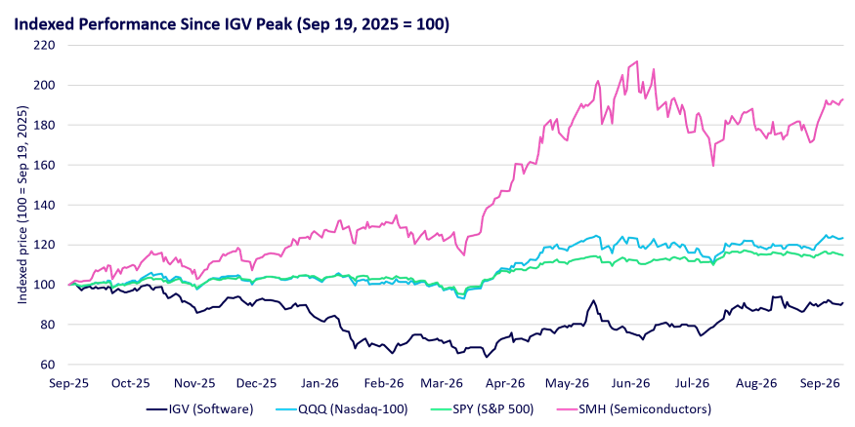
Software stocks have rebounded following the SaaSpocalypse, but the recovery has been selective. Investors watching only the S&P 500 and Nasdaq would have missed a bear market in enterprise software. From its September 2025 peak, the IGV software ETF fell 36% before bottoming in April as investors questioned whether AI agents would replace SaaS tools and undermine per seat pricing. The selling was widespread, with 85 of the 91 public enterprise SaaS companies in our sample declining and 64 losing at least 30% of their value. Since then, IGV has regained much of its losses, and 41% of the companies we track now trade above their September peak. Meanwhile, semiconductor stocks have surged, helping lift the broader indices even as software lagged. Investors are increasingly distinguishing between software companies positioned to benefit from AI and those at risk of displacement.
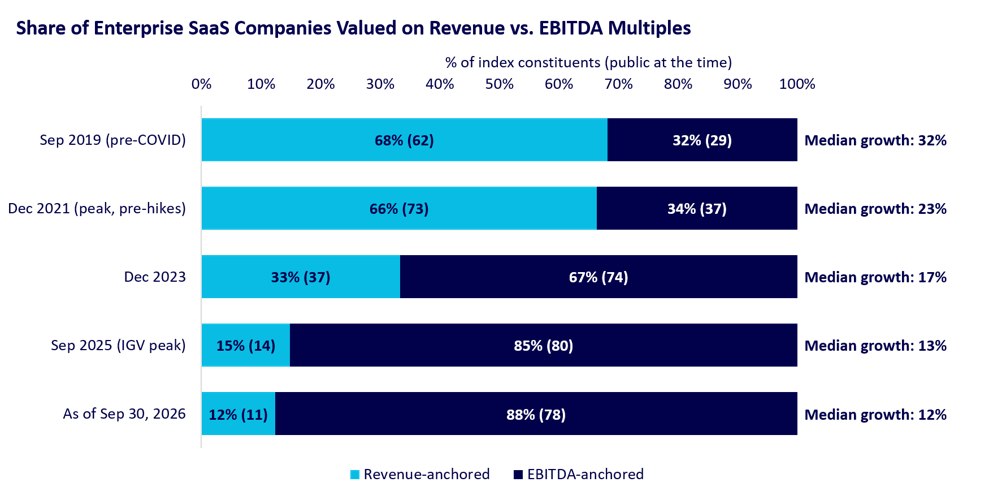
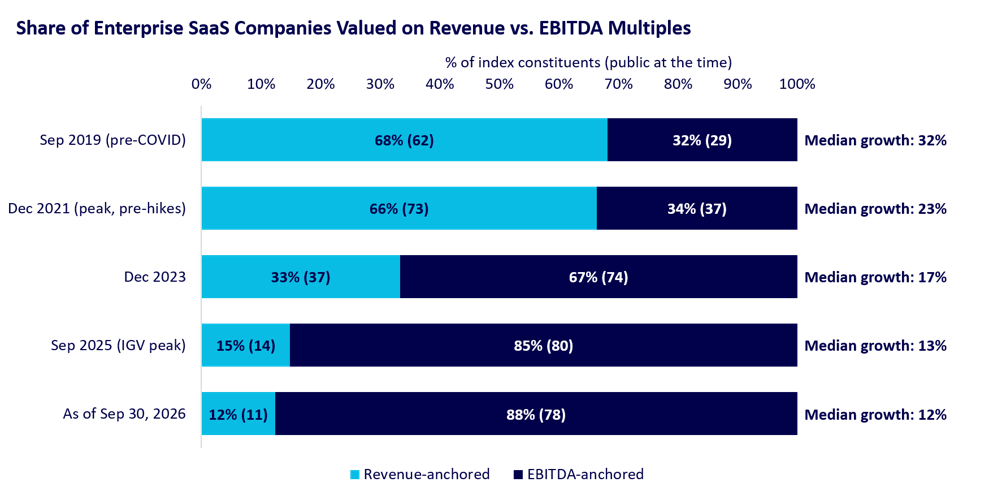
Profitability now anchors SaaS valuations, increasing the value of businesses that also deliver growth. Across our broader, publicly-traded enterprise SaaS sample, the share of companies valued on EBITDA multiples climbed from 32% in 2019 to 88% today as interest rates rose. Meanwhile, median revenue growth has fallen from 32% in 2019, before COVID, to 12% today. The SaaSpocalypse added further pressure on valuations, with 38% of companies now trading above 15x EBITDA, down from 53% a year ago. The effects of higher rates, AI disruption concerns, and trading growth for profit are difficult to separate, but together they have reshaped the market. For buyers, lower valuations offer more attractive entry points. For sellers, profitable growth remains scarce and commands a premium.
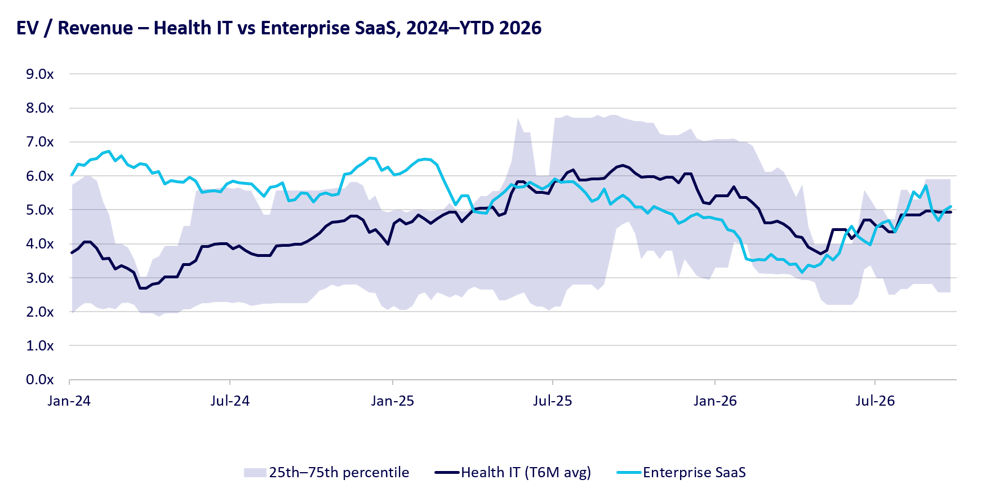
For the first time since HGP launched its index in 2016, Health IT has closed its valuation discount to public enterprise SaaS. Based on HGP’s database of Health IT M&A and buyout transactions, the index shows that Health IT revenue multiples held up better during the SaaSpocalypse than public enterprise SaaS multiples. Both have recovered since April and now sit at similar levels. Health IT’s relative resilience may reflect its structural moats, including deeply embedded clinical workflows, regulatory expertise and high switching costs. These advantages can both protect incumbents from disruption and position them to deploy AI within the systems and customer relationships they already have.
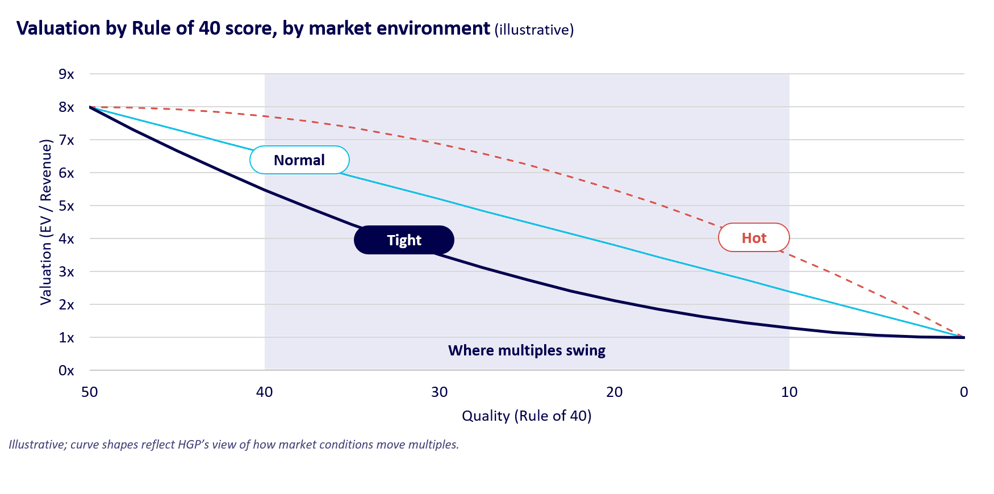
Quality supports premium valuations, while market timing matters most for companies in the middle. HGP’s illustrative framework below shows how market conditions affect valuations across the Rule of 40 spectrum, which combines revenue growth and profitability. At the highest scores, strong businesses can command premium multiples in any market. For companies with scores between 10 and 30, however, the valuation gap between a hot and tight market can span several turns of revenue. Buyers become more selective as conditions tighten, placing greater weight on proven growth, margins and retention. For sellers in this middle range, improving performance and choosing when to enter the market can both materially affect value. The curves are a guide rather than a ceiling: companies with a compelling growth outlook or strategic fit for an acquirer can command valuations above what their current financial metrics suggest.
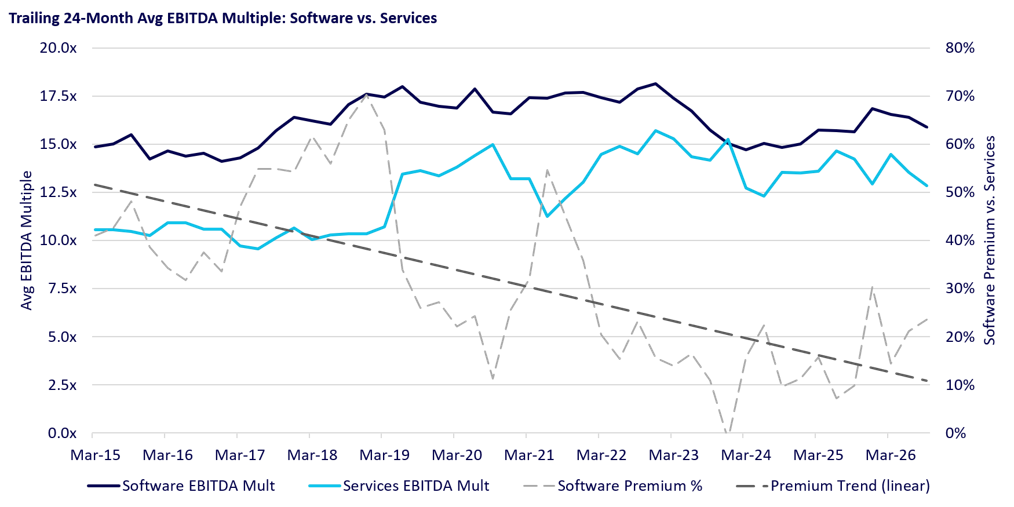
Health IT Services have narrowed the valuation gap with Software as technology changes how services businesses scale. HGP’s trailing 24 month average EBITDA multiples show services valuations moving higher over time while software valuations have remained relatively stable. AI may accelerate this trend by enabling services companies to automate more work, operate with leaner teams and take on more complex outsourced functions. That creates opportunities to expand both the scope of services and the number of customers served without a corresponding increase in headcount. For Health IT companies, adding recurring services can be a more attractive way to grow, with less of the valuation discount historically associated with a larger services mix.
Higher expectations and new opportunities are shaping Health IT’s next chapter. The market has become more selective, but Health IT has held up better than broader software, and the valuation gap between services and software has narrowed. For owners and investors, the opportunity is to build on those strengths, using AI to improve margins and expand what existing businesses can deliver. With growth harder to find, companies that do both have a stronger case for premium valuations.
For the latest trends in Health IT M&A, buyout and investment activity, along with noteworthy transactions, visit the: HGP Momentum Index.